Why Flashcards Help Japanese Vocabulary Stay Longer
Flashcards are simple but powerful. Learn how active recall and FSRS review timing help Japanese vocabulary stay longer.
In an age full of flashy AI learning apps, flashcards may seem a little plain. Maybe even old-fashioned.
But there is a reason flashcards have remained a learning tool for so long.
Few tools follow the principles of memory as honestly as they do.
What matters in Japanese vocabulary study is not a huge set of fancy features.
See it. Retrieve it from memory. Check it.
Flashcards train these three basics in the most direct way.
Seeing and Retrieving Are Completely Different
When you scroll through a vocabulary list, it is easy to feel this illusion:
“Oh, I think I know this word.”
But before flipping the card, try recalling the meaning on your own.
You will know right away.
Was it a word you truly knew?
Or was it just a word that felt familiar because you had seen it before?
Flashcards make that difference clear.
Active Recall
This is not studying by looking at the answer.
It is studying by pulling the answer out of your brain.
A word you struggle to retrieve on your own stays much longer than a word you simply glance at.
That is why flashcards are simple, but powerful.
What Matters More Than Seeing Words Often Is Timing
Flashcards are useful.
But endlessly repeating a stack of cards is not efficient.
If you keep reviewing words you already know well, you get tired.
If you see a word again too late, you may have already forgotten it and need to memorize it from the beginning.
The problem is not the card.
It is the timing.
Can you review the card again at just the right moment, right before the memory starts to fade?
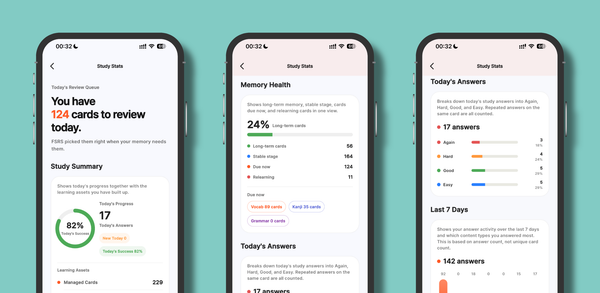
This is where Manana’s FSRS, a next-generation spaced repetition algorithm, comes in.
Every Card Review Shapes the Next Review Schedule
In Manana, the moment you review a flashcard, the result does not simply disappear.
- Words you struggle with or miss come back sooner.
- Words you answer confidently move further into the future.
Each piece of feedback from a card review becomes a signal that helps Manana understand your memory state.
That is why Manana’s flashcards are not just cards.
They are inputs that adjust your next review based on the speed of your memory.
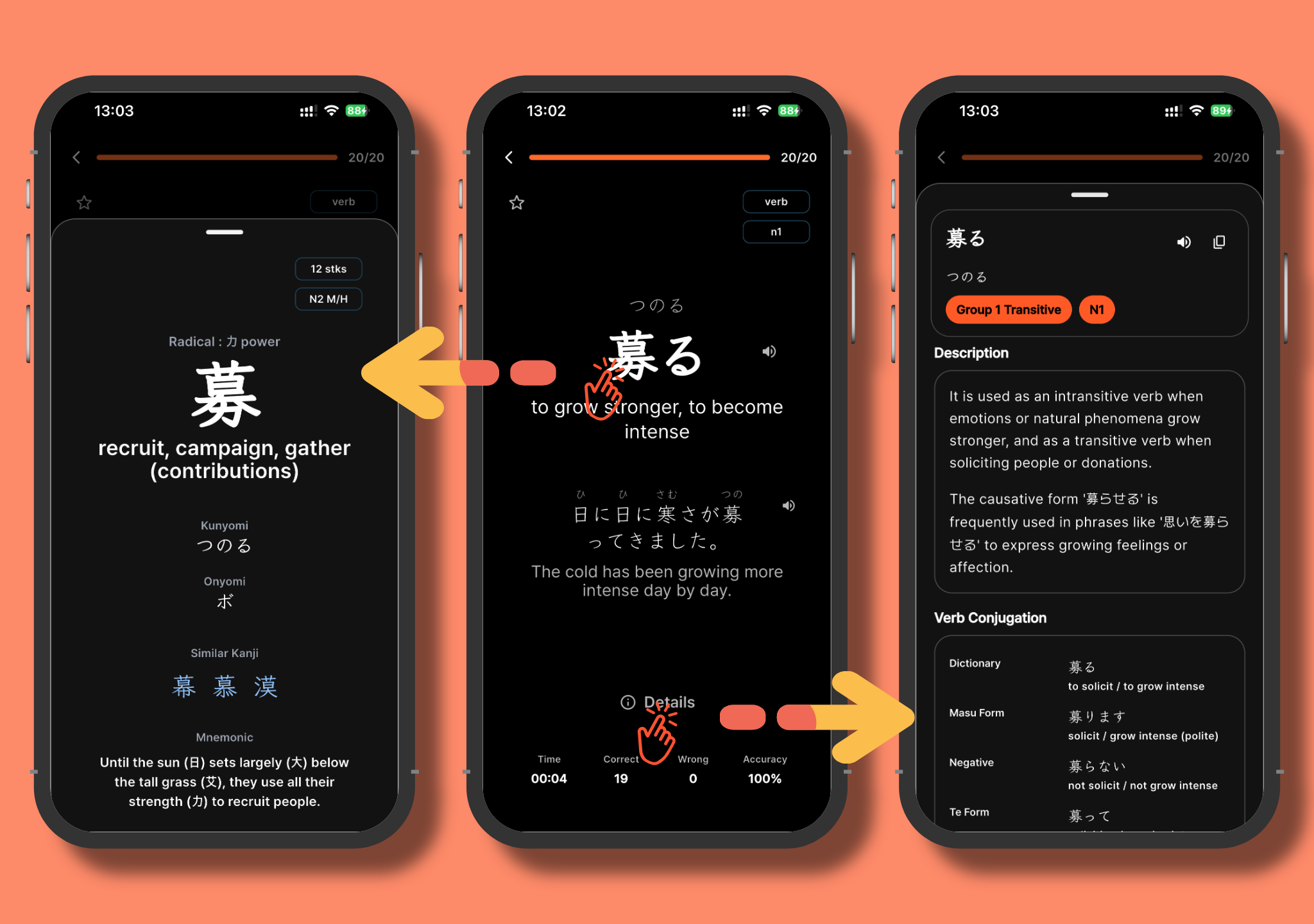
Reviewing a Word from Multiple Angles
If you only memorize a word and its meaning, it fades easily.
That is why Manana connects each word with different senses and contexts.
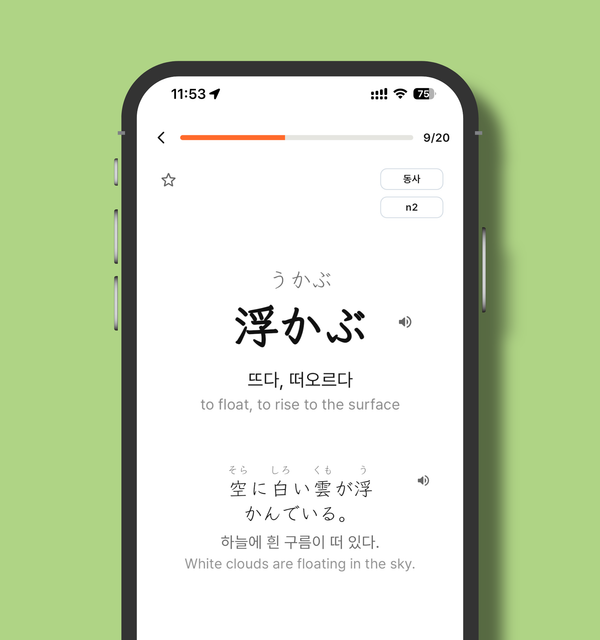
- When the meaning is hidden, your brain moves first to retrieve it.
- When you choose an answer, the FSRS algorithm calculates the best next review interval.
- When you read an example sentence, you understand how the word is used in context.
- When you hear TTS audio, the text connects with sound and becomes clearer in memory.
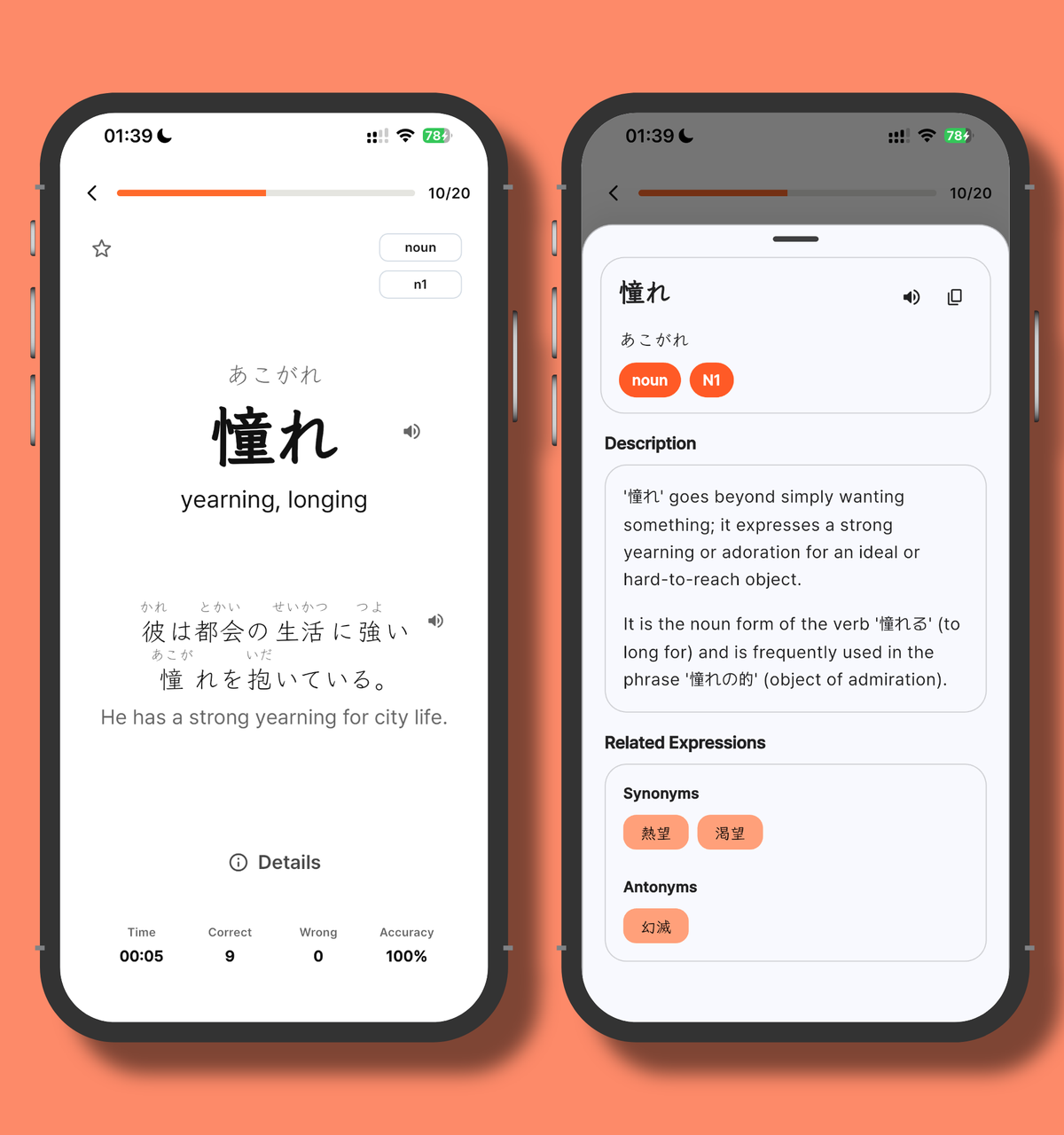
- When you see synonyms and antonyms, the boundaries of meaning become sharper.
- When you check the kanji, you can see the structure and meaning clues behind the word.
Manana’s flashcards do not stop at one-time memorization.
They connect a word tightly with sentences, sound, and kanji.
How to Study with Manana
You do not need to worry about the algorithm.
Just follow the flow.
- Look at the card and try to recall the meaning first.
- If you cannot remember it, honestly choose “I don’t know.”
- Lightly review the example sentence, audio, and kanji.
- Then leave the next review schedule to Manana’s algorithm.
Words you need to review today.
Words that can wait until tomorrow.
Words you do not need to see for a while.
Manana brings them back at the most efficient moment for your memory cycle.
Long-Lasting Memory Works Differently
Words do not enter long-term memory just because you see them often.
They become yours when you first try to retrieve them,
meet them again at the right moment before forgetting,
and confirm their meaning in sentences and sound.
Flashcards are not outdated.
They are close to one of the most essential ways humans remember things,
and Manana carries that method forward with smarter digital technology.
Flip a card lightly each day.
The words you once had to force yourself to hold on to will slowly begin to stay.
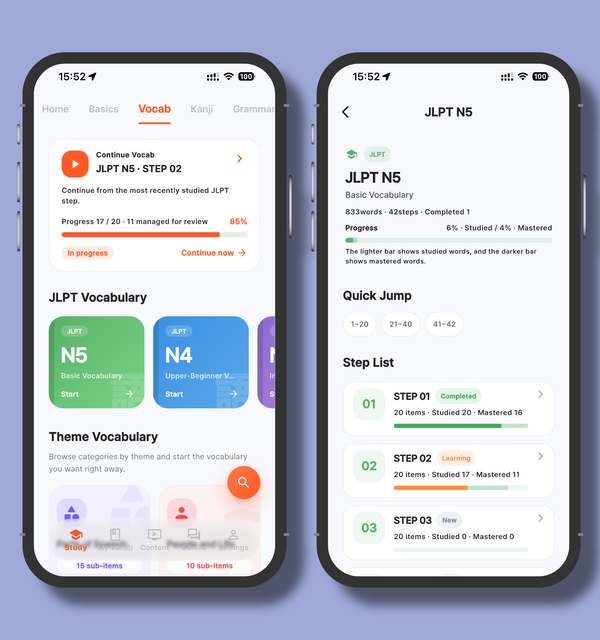
Manana Japanese is a Japanese learning app that connects JLPT vocabulary, Japanese kanji, FSRS review, and reading content into one continuous study flow.