FSRS: The Timing of Memory
If you forget Japanese vocabulary soon after studying it, the problem may be review timing rather than willpower. Learn how Manana Japanese uses FSRS to decide when to review.
If you study hard but forget quickly,
the problem may not be you.
It may be the timing of your review.
To remember Japanese vocabulary for longer, it is not enough to simply see words more often. What matters is reviewing them at the right moment, just before they fade from memory.
Manana Japanese uses FSRS, a modern spaced repetition algorithm developed from large-scale learning data. It is not just simple repetition. It is review adjusted to the memory state of each word.
What Is FSRS?
An algorithm that predicts the forgetting curve
FSRS stands for Free Spaced Repetition Scheduler. It is a next-generation algorithm for spaced repetition. It predicts when you are likely to forget something and shows review cards at the right time, before the memory becomes too weak.
Instead of only judging whether a word is easy or difficult, FSRS calculates memory state using three factors: Difficulty, Stability, and Retrievability.
The Limits of Older Algorithms
Why do older apps often become tiring?
For decades, SM-2-based algorithms were used almost like a standard in many flashcard apps. But they have limitations when it comes to reflecting each learner’s memory pattern in detail. Fixed rules are applied in largely the same way to everyone.
One of the biggest issues is often called Ease Hell. If you mark a card as difficult once, it can continue appearing more often than necessary, even after you have become familiar with it. Unnecessary repetition builds up, study fatigue increases, and eventually you close the app.
Manana needed an engine that could respond more flexibly to each learner’s memory state.
That answer was FSRS.
Benefits of FSRS in Manana
1. Less Review Burden
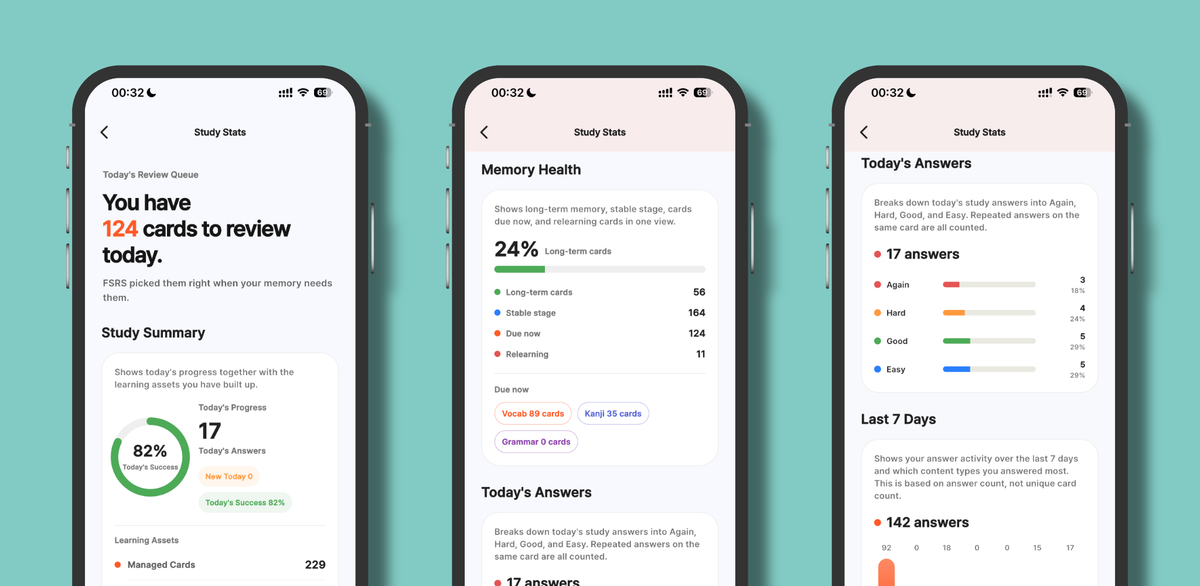
FSRS predicts forgetting timing more precisely and helps reduce unnecessary early reviews. Instead of repeating words you already know, it helps you focus on the words you actually need to review now.
2. Escaping Ease Hell
A word does not stay trapped in short review intervals forever just because you missed it once. FSRS reflects your later answers and gradually brings the card back toward a more normal schedule. This makes it easier to answer honestly without being afraid of getting something wrong.
3. Same-Day Memory Consolidation
FSRS also considers the rapid early forgetting that can happen on the day you first learn an unfamiliar word. It aims to catch short-term memory before it disappears and help move it toward long-term memory.
4. 90% Memory Retention
Manana currently builds review schedules based on FSRS’s default target retention of 90%. The goal is to avoid showing cards too early and wasting your time, while also avoiding showing them too late after you have completely forgotten them.
5. Review That Adapts to You
FSRS updates each word’s difficulty and memory stability based on your actual review history. It then calculates different review timings for different learners. The more you study, the closer the schedule becomes to your own memory state.
Review Is Not Just Willpower. It Is Timing.
Language learning is a long marathon.
So that your effort is not wasted on meaningless repetition, Manana guides you toward more accurate review timing.
Less time, more progress.
Start today.
Why FSRS Improves on SM-2
| Category | SM-2 | FSRS | What You Feel with FSRS |
|---|---|---|---|
| Review Load | 100% (heavy) | 70%–80% | About 20–30% less daily review |
| Accuracy | Lower (error ~14%) | Higher (error ~4%) | A schedule tailored to your memory pattern |
| Efficiency | More wasted time | High efficiency with less time | Less repeated review of words you already know |
| Weakness | Ease Hell | Not applicable | Far fewer cards piling up |
| Control | No target retention setting | Target retention can be set | Adjust review intensity for your exam or schedule |
Source:
- Open Spaced Repetition / SRS Benchmark (GitHub)
Why FSRS Goes Beyond the Ebbinghaus Forgetting Curve
| Category | Ebbinghaus Theory | FSRS | What You Feel with FSRS |
|---|---|---|---|
| Basis | Average human forgetting | Each learner’s own forgetting pattern | Personalized review based on individual data, not group averages |
| Interval | Fixed intervals such as 1 day or 1 week | Flexible intervals based on learning responses | Review intervals adjust based on your answers, reducing repeated review |
| Personalization | None; based on experimental averages | Personalized scheduling | Optimized review timing with an error rate around 4% |
| Control | No control over retention rate | Target retention is reflected | Set a memory retention target, such as 90%, based on your learning goal |
Sources and References:
- Hermann Ebbinghaus, Memory: A Contribution to Experimental Psychology
- Open Spaced Repetition / SRS Benchmark (GitHub)
- FSRS Algorithm Wiki (GitHub Wiki)